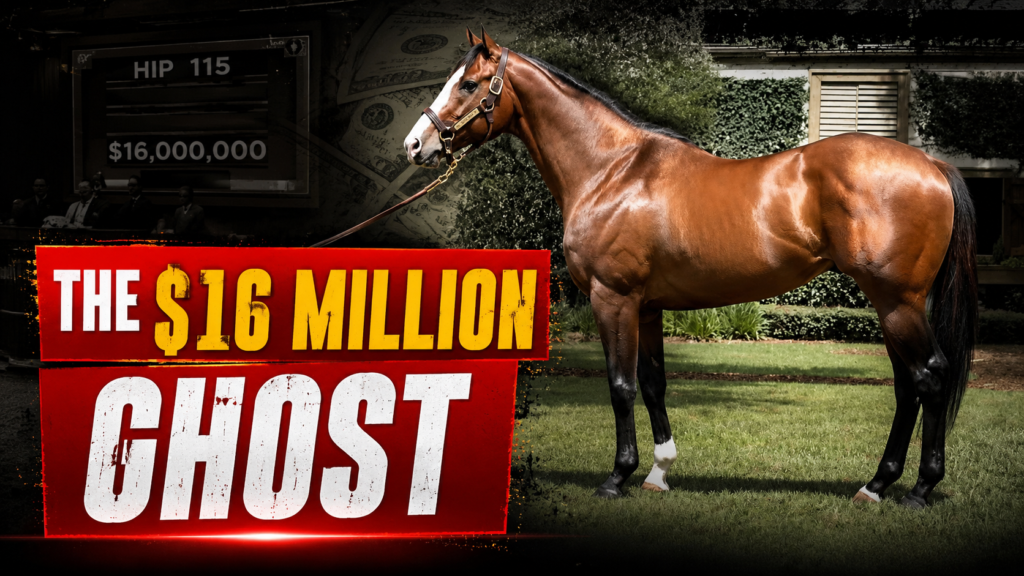
In the history of Thoroughbred racing, few stories are as shocking, controversial, and unforgettable as that of The Green Monkey. In 2006, during an era when global racing giants were locked in an intense battle for supremacy, a stunning bay colt shattered every auction record in existence when he sold for an astonishing sixteen million dollars, the equivalent of more than twenty-five million dollars today. His price obliterated the previous two-year-old sales record of five point two million dollars and even surpassed the all-time public auction record set by Seattle Dancer in 1985. With bloodlines tracing to legends like Northern Dancer and Secretariat, a flawless physical appearance, and a breathtaking one-furlong breeze in nine and four-fifths seconds, he appeared to be the perfect racehorse. But what happened next stunned the entire racing world. Instead of becoming a champion, The Green Monkey became the most expensive disappointment in horse racing history. How did a horse valued at sixteen million dollars become known as the ghost? This is the incredible story of ambition, hype, biomechanical flaws, devastating injuries, shattered expectations, and one of the greatest financial failures the sport has ever witnessed.
THE GENETIC BLUEPRINT
Long before The Green Monkey became one of the most infamous names in Thoroughbred history, his story began with a pedigree that seemed almost too perfect to fail. Bred in Florida by Satish and Anne Sanan’s Padua Stables and foaled on February 4, 2004, the bay colt represented a carefully assembled blend of speed, precocity, and classic stamina. Every branch of his bloodline had been selected to appeal to the highest levels of the commercial bloodstock industry. To buyers and breeders, he appeared to be the physical embodiment of some of the most influential sire lines of the late twentieth century. On paper, he looked less like a racehorse and more like a masterpiece designed specifically for greatness.
The foundation of that promise came from his sire line. The Green Monkey was sired by Forestry, a Grade One-winning son of the legendary Storm Cat. During the years surrounding The Green Monkey’s birth and eventual sale, Storm Cat stood at the very top of the commercial breeding world. His offspring were famous for their immense muscularity, explosive speed, and overwhelming appeal in the sales ring. Buyers around the globe competed aggressively for anything carrying the Storm Cat name. Forestry, who stood at the respected Taylor Made Farm, was widely viewed as one of Storm Cat’s most promising sons and a stallion capable of extending the dynasty into a new generation.
What made Forestry especially attractive was the balance within his own pedigree. His dam, Shared Interest, was a daughter of Pleasant Colony, a stallion known for passing on stamina and endurance. To bloodstock experts, this suggested the possibility of combining Storm Cat’s brilliance and speed with the staying power required for classic dirt races. It was exactly the type of genetic equation the marketplace craved.
The Green Monkey appeared to inherit the very best qualities of that sire line. He was an exceptionally handsome bay colt marked by a distinctive white blaze and two white socks. His physique immediately captured attention. He possessed the long body, powerful frame, and massive musculature that had become the unmistakable trademarks of the Storm Cat family. Standing before him, buyers saw everything they hoped a future champion would look like. Yet hidden beneath that impressive appearance was a reality that would only become clear years later. Historical analysis of Forestry’s broader record eventually revealed that he was considered only a fair sire overall, and many of his offspring displayed fragility rather than lasting structural soundness. Despite breeding with outstanding mares, Forestry’s greatest accomplishment as a stallion would ultimately become Shackleford, the winner of the 2011 Preakness Stakes. Ironically, that future success was linked directly to the commercial popularity generated by the very pedigree cross that made The Green Monkey so valuable.
While his sire line supplied speed and commercial appeal, the bottom half of his pedigree added another crucial ingredient. The Green Monkey was the second foal produced by the chestnut mare Magical Masquerade, a daughter of the 1990 Kentucky Derby winner Unbridled. Throughout the Thoroughbred industry, Unbridled was admired for transmitting enormous stride length, durability, and the ability to carry speed over demanding route distances. As a son of Fappiano, he represented one of the most respected sources of classic stamina in modern American breeding.
Magical Masquerade was a half-sister to multiple Grade Two winners, including Magicalmysterycat and Burmilla, both of whom were sired by Storm Cat. Their success demonstrated that this female family already possessed a proven affinity for the Storm Cat line. To breeders and buyers, that evidence suggested the Forestry and Unbridled combination had every chance to produce something exceptional.
The strength of the family extended even deeper. The Green Monkey’s second dam was Nannerl, a multiple Grade Two winner by Valid Appeal. Behind her stood a rich female lineage influenced by In Reality, Proud Clarion, and Rough ‘N Tumble. Every layer of the pedigree seemed to reinforce the same message. This was a colt bred from generations of proven class, speed, and durability.
A closer examination of his five-generation pedigree only intensified the excitement. The Green Monkey carried an inbreeding pattern of four-by-five to the legendary Dr. Fager, one of racing’s most influential speed sources. Combined with the presence of Northern Dancer, Secretariat, and Raise a Native, the pedigree appeared virtually flawless. To bloodstock agents and breeders, it represented an ideal concentration of elite genetic influences.
FROM YEARLING TO PRODIGY
As impressive as his pedigree was, The Green Monkey’s path toward history required another crucial step. His transformation from promising yearling to international sensation began through the high-risk business of pinhooking. At the 2005 Fasig-Tipton Kentucky Select Yearling Sale, bloodstock partners Randy Hartley and Dean De Renzo spotted something special in the imposing Forestry colt. Believing his potential justified the risk, they purchased him for four hundred twenty-five thousand dollars.
Even at the time, the decision stretched their financial limits. Hartley would later acknowledge that they had exceeded the budget they originally intended to spend. Yet they were convinced the colt possessed the physical tools necessary to justify the gamble. What happened next would validate their confidence beyond anything they could have imagined.
Over the next seven months in Ocala, Florida, The Green Monkey underwent an intensive development program designed specifically for the elite two-year-old sales market. Every aspect of his preparation focused on showcasing athleticism, maturity, and speed. As he continued to develop, his appearance became even more impressive. His powerful frame, heavy musculature, and commanding presence drew increasing attention from industry insiders. With every workout, anticipation grew. By the time he approached the sales ring as a two-year-old, he had evolved into exactly the type of prospect capable of attracting the wealthiest owners and investors in world racing.
THE CALDER BREEZE
Everything changed in early 2006 during the under-tack show for the Fasig-Tipton Florida Select Two-Year-Olds in Training Sale at Calder Race Course. For young racehorses, the under-tack show serves as one of the most important evaluations of their careers. Prospective buyers, trainers, and bloodstock agents gather to watch juveniles sprint short distances while assessing their speed, stride mechanics, athleticism, and overall movement. A strong performance can dramatically increase a horse’s value. A truly extraordinary performance can create history. When the Forestry colt stepped onto the dirt track, he delivered exactly that.
What happened next stunned everyone in attendance. The Green Monkey covered one furlong in an astonishing nine and four-fifths seconds. In 2006, breaking the ten-second barrier represented both a psychological and physical milestone. No sales horse had ever officially recorded a public auction furlong time faster than ten seconds. Suddenly, the colt had done exactly that.
The reaction was immediate. Buyers and observers watched in amazement as the stopwatch confirmed what their eyes believed they had just witnessed. The combination of breathtaking speed and seemingly effortless motion electrified the sales grounds. In a matter of seconds, The Green Monkey transformed from a promising prospect into the most talked-about horse in the auction. But behind the excitement, another story was quietly unfolding.
THE ROTARY GALLOP
Although the stopwatch suggested generational talent, a handful of biomechanical experts saw something entirely different when they reviewed the performance in slow motion. To them, The Green Monkey represented what could be described as a false positive.
The issue centered on his locomotion. The colt displayed a rotary gallop, also known as cross-cantering, a movement pattern in which the sequence of footfalls resembles that of a dog or cheetah rather than the healthy transverse stride expected from a Thoroughbred racehorse. While this type of motion can create explosive acceleration over very short distances, it carries severe biomechanical consequences over longer racing trips.
The flawed stride forced the horse to move in an unbalanced and asymmetric manner, placing tremendous stress on both the skeletal and muscular systems. Knowledgeable observers immediately recognized the movement as unsustainable and highly inefficient for racing success. To those experts, the workout revealed a significant structural weakness rather than a future champion.
Yet their concerns were drowned out by the excitement surrounding the performance. The major international buyers focused on the astonishing time and the colt’s impeccable pedigree. The pursuit of raw speed overwhelmed physiological reality. In that moment, the warning signs were largely ignored.
THE 2006 FASIG-TIPTON CALDER AUCTION
The stage was now set for one of the most dramatic auction battles in Thoroughbred history. In 2006, the global economy remained strong, and the bloodstock industry was fueled by an intense rivalry between two of the sport’s most powerful forces: Coolmore Stud of Ireland and the Darley-Godolphin operation of Dubai.
When the remarkable Forestry colt entered the ring at the Fasig-Tipton Calder Sale, tension immediately filled the building. What followed was not merely an auction. It was a financial showdown between racing empires.
Coolmore’s representative, Demi O’Byrne, and Darley’s agent, John Ferguson, quickly became locked in a fierce bidding duel. As the numbers climbed higher and higher, auctioneer Walt Robertson deliberately slowed his normally rapid chant. The room watched in disbelief as the price surged past one million dollars. Then it crossed five million. Moments later it moved beyond eight million, then ten million, and still the battle continued.
For nearly nine extraordinary minutes, the two industry giants exchanged bids in what many witnesses later described as outright financial warfare. The tension became almost unbearable as each side refused to surrender.
Finally, the contest reached its conclusion. Darley stepped aside. Coolmore delivered the winning bid.
The final price was sixteen million dollars.
The number instantly shattered every previous record for an unraced two-year-old sold at public auction. For consignors Randy Hartley and Dean De Renzo, the sale generated a profit exceeding fifteen and a half million dollars. It was one of the greatest returns ever achieved through pinhooking.
As the excitement settled, Demi O’Byrne delivered a comment that would become one of the most memorable quotes in auction history. Looking at the newly purchased colt, he simply said, “He’d better be good. Time will tell.”
Soon afterward, the horse received the name The Green Monkey. The name was inspired by the exclusive Green Monkey golf course in Barbados and by the fact that he had been born during the Chinese Year of the Green Monkey. The symbolism seemed fitting for a horse who had already become a global sensation before ever stepping onto a racetrack.
Years later, other records would be established for proven racehorses and elite stallion prospects. Yet despite all those transactions, one fact remains unchanged. The Green Monkey still stands as the most expensive untried and unraced horse ever sold at a public auction, a distinction that continues to make his story one of the most fascinating and controversial chapters in the history of Thoroughbred racing.
THE RACING CAREER
After the historic sixteen million dollar purchase, The Green Monkey was placed in the care of multiple Eclipse Award-winning trainer Todd Pletcher, one of the most respected horsemen in the sport. The challenge facing Pletcher was immense. Expectations had reached unprecedented levels, and every decision had to balance aggressive preparation with the need to protect the colt’s long-term health. Yet beneath the excitement surrounding the world’s most expensive unraced horse, troubling warning signs were already beginning to emerge. The biomechanical flaws that sharp observers had identified during his record-setting breeze at Calder had not disappeared. In fact, the physical demands of sustaining a rotary gallop at maximum speed would soon expose serious vulnerabilities within his body. What had looked like extraordinary athleticism was about to collide with biological reality.
ANATOMICAL FAILURE: THE SARATOGA GLUTEAL INJURY
The Green Monkey joined Pletcher’s stable in April 2006 and appeared to be progressing toward his long-awaited racing debut. By late July, he had been shipped to the prestigious Saratoga Race Course, where many of the sport’s brightest stars launch their careers. But in early August, disaster struck. During a routine five-furlong workout timed in a sharp one minute, three and forty-four hundredths seconds, the colt suffered a significant injury when he pulled a gluteal muscle.
This setback was far more serious than it initially appeared. The gluteal muscles, which cover the ilium and gluteal fossa of the equine pelvis, serve as the primary source of propulsion during a Thoroughbred’s gallop. These muscles generate the explosive power required for speed and extension. Injuries in this area often indicate that a horse is compensating for unbalanced movement patterns or cross-firing mechanics. In The Green Monkey’s case, his rotary gallop created uneven distribution of kinetic energy throughout his spine and pelvis. Instead of moving efficiently, abnormal shear forces repeatedly stressed his hindquarters. The consequences were devastating.
This moment changed everything. Before he could even make a start, his entire two-year-old campaign was effectively destroyed. He was sent to Coolmore’s Ashford Stud in Versailles, Kentucky, for an extensive rehabilitation program. Unfortunately, the injury proved stubborn and difficult to overcome. When he attempted to resume light training in November, he aggravated the same gluteal muscle once again. The setback extended his recovery and forced a lengthy layoff that stretched deep into the summer of his three-year-old season. Looking back years later, Dean De Renzo reflected on the colt’s fragility and the lasting effects of the injury. He explained that the pain from the damage sustained during The Green Monkey’s two-year-old season prevented him from ever moving the way he had before the injury occurred, despite numerous attempts to bring him back.
THE ANTICLIMACTIC DEBUTS
Months passed before any meaningful progress could be seen. The Green Monkey did not appear on a recorded workout tab again until June 2007. Even then, Pletcher remained cautious. It was not until the autumn of his three-year-old season that the trainer finally believed the colt was physically sound enough to race.
On September 15, 2007, an astonishing nineteen months after becoming a sixteen million dollar sensation, The Green Monkey finally stepped onto a racetrack for his debut. The venue was Belmont Park, and the race was a six-furlong maiden special weight event. The public eagerly anticipated the arrival of the supposed prodigy, sending him off as the overwhelming two-to-five favorite. For a brief moment, it seemed as though the long wait might finally be justified. He broke adequately from the gate, but when the race intensified, the acceleration everyone expected never materialized. Instead of surging past his rivals, he maintained a single pace and finished third behind Roi Maudit and Sixthirteen. His Equibase Speed Figure was a modest eighty-nine, a number well below the standard expected of a future stakes performer.
The disappointing debut did not end the experiment. Hoping the colt simply needed a different challenge, Pletcher stretched him out for his second start on October 13, 2007. Once again at Belmont Park, The Green Monkey entered a seven-furlong maiden race against six rivals. This time he showed more early ambition, contesting the pace in the opening stages. However, as the field entered the stretch, his energy rapidly disappeared. He weakened badly and finished a distant fourth behind Giant Deputy, who completed the race in one minute, twenty-one and twenty hundredths seconds. The same stride mechanics that had produced extraordinary speed over a single furlong at Calder offered no advantage over a much longer racing distance. Against genuine competition, the flaws became impossible to ignore.
Searching for answers, Pletcher made one final attempt. Perhaps a different surface could ease the strain on the colt’s body and help unlock some of the talent that had once captivated the racing world. With that hope in mind, The Green Monkey was shipped to California. On November 21, 2007, he made the third and final start of his career in a one-and-one-sixteenth-mile maiden race on the turf at Hollywood Park Racetrack. Once again, there were brief flashes of promise. He moved forward and challenged for the lead on the backstretch, suggesting for a moment that improvement might be coming. But when asked for his maximum effort, he faded badly and finished fourth. His Equibase Speed Figure dropped slightly to eighty-seven.
At that point, reality could no longer be avoided. Coolmore recognized that The Green Monkey lacked both the physical durability and the physiological stamina necessary to compete successfully, even at the maiden level. On February 12, 2008, the decision was made to retire him from racing. The results were staggering. The horse purchased for sixteen million dollars earned just ten thousand four hundred forty dollars in purse money. The loss sent shockwaves throughout the Thoroughbred industry and fundamentally challenged long-held assumptions about evaluating young horses. The Green Monkey had become known as the sixteen million dollar ghost.
THE STUD CAREER
Although his racing career had ended in disappointment, The Green Monkey still possessed one asset that retained value: his pedigree. The challenge facing his owners was whether those celebrated Forestry and Unbridled bloodlines could generate enough commercial interest to justify a stallion career. In Thoroughbred breeding, a stallion’s fee is driven primarily by race performance and pedigree strength. The Green Monkey still possessed the latter, but his racing record offered virtually nothing to support his credentials.
In an effort to recover some value from the investment, Coolmore executed a strategic arrangement by selling a half-interest in the horse back to the original pinhookers, Randy Hartley and Dean De Renzo. The Green Monkey returned to Florida and began his stud career at Hartley and De Renzo Thoroughbreds in Ocala in 2009. The syndication agreement included an intriguing performance clause. If his offspring achieved significant success, he could eventually be moved to Coolmore’s elite Ashford Stud operation in Kentucky. However, that provision would never be activated.
His opening stud fee reflected the dramatic collapse of his commercial standing. Set at just five thousand dollars, it represented approximately a ninety-nine point ninety-six percent decline from his sixteen million dollar auction valuation. Dan Rapp, the farm’s bloodstock consultant, presented the fee as an opportunity for regional breeders, explaining that the stallions were priced in a way that would allow breeders the possibility of making a profit.
During his first breeding season in 2009, curiosity alone generated respectable interest. The novelty of breeding to the world’s most expensive auction horse, combined with his exceptional pedigree, attracted a book of forty mares. His first reported foal arrived on January 13, 2010. The filly, later named Your Lovely and produced from the mare I’m Angela, eventually became a winner.
But the initial curiosity did not last. As more of his offspring reached the racetrack, enthusiasm steadily faded. Breeders became increasingly reluctant to support him. In the years that followed, The Green Monkey never covered more than twelve mares in a single season. Across his entire abbreviated stud career, he produced only forty-two to forty-six foals of racing age.
Despite the limited opportunities, there were occasional flashes of regional success. His most accomplished offspring was Green Doctor, who earned more than three hundred thirty-five thousand dollars during her career. Her signature achievement came in the 2014 Fanfreluche Stakes at Woodbine, a prestigious six-furlong event for Ontario-bred two-year-old fillies run on the synthetic surface. She captured the race in one minute, ten and seven hundredths seconds.
Beyond Green Doctor, The Green Monkey managed to achieve black-type representation in Panama and Puerto Rico. However, none of his offspring made a meaningful impact at the highest levels of North American racing. As a stallion, he was widely regarded as a disappointment, unable to transmit the elite ability that his pedigree appeared to promise. Even as a broodmare sire, his influence remained limited. His daughters collectively produced an Average Earnings Index of just zero point eighty-nine, indicating earnings below the overall average for racing progeny.
THE FINAL YEARS
As disappointing as his racing and breeding careers had been, the most difficult chapter of The Green Monkey’s story was still to come. In late 2016, the stallion developed laminitis, one of the most painful and devastating diseases that can affect a horse.
Hartley and De Renzo spared no effort in caring for the horse. Determined to maximize his comfort, they built a specially designed oversized stall that provided direct access to a private paddock. The arrangement allowed him to move freely and naturally without being forced to make painful turns in a confined space. Every possible measure was taken to support him as the disease progressed.
For more than a year and a half, the farm fought aggressively to save him. Veterinary teams worked tirelessly, and his caretakers remained committed to giving him every chance. But eventually the disease became impossible to overcome.
In the spring of 2018, The Green Monkey’s quality of life deteriorated beyond an acceptable level. Faced with an impossible decision, his connections chose to euthanize the fourteen-year-old stallion in May 2018. The horse who had once captivated the entire Thoroughbred world was gone.
The Green Monkey was buried at the Hartley and De Renzo farm in Ocala. Yet even in death, he remained special to the people whose lives he had changed forever. Recognizing his extraordinary impact on their business and personal journey, the farm transformed his stall and enclosure into a permanent memorial. Randy Hartley explained that no other horse would ever occupy that space because it held unique meaning. He reflected on the bond they shared, saying there would never be another horse like The Green Monkey for them and expressing gratitude for everything the horse had brought into their lives.
His racing career ended in disappointment. His stallion career never fulfilled its promise. Yet decades after a nine and four-fifths second breeze changed the Thoroughbred industry forever, The Green Monkey remains one of the most unforgettable cautionary tales in horse racing history. He was the horse who became a legend before he ever won a race, the sixteen million dollar ghost whose story continues to remind the sport that pedigree, appearance, and auction records can never guarantee greatness. Thanks for watching.