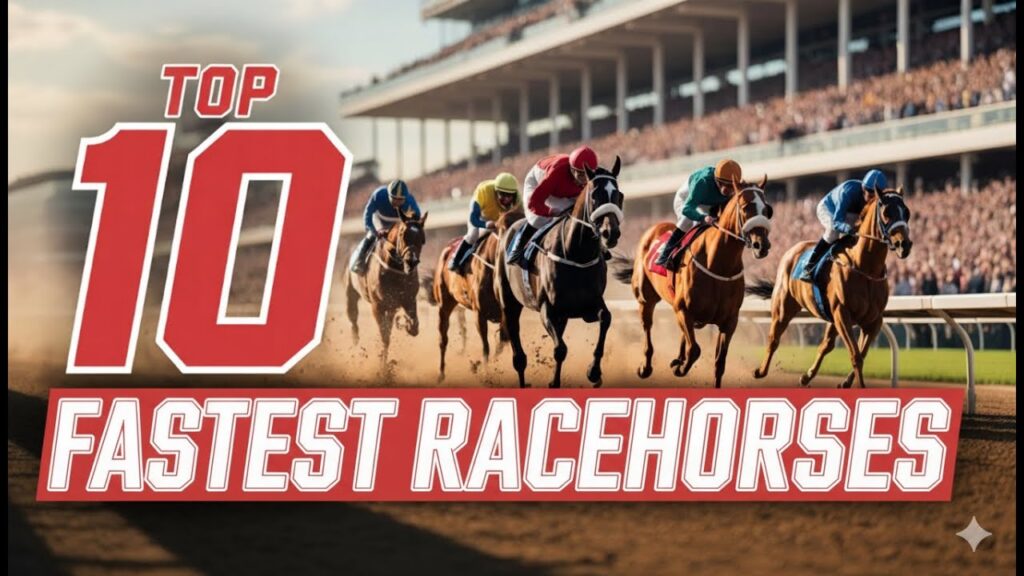
Few things in horse racing are more thrilling than watching a Thoroughbred unleash its full speed down the track. Over the decades, a select group of racehorses have separated themselves from the field through extraordinary acceleration, record-breaking performances, elite race times, and remarkable consistency.
But determining the fastest racehorse in history is not as simple as comparing one speed figure. Track conditions, distance, surface, racing style, timing methods, competition, and the era in which a horse competed all matter.
From the legendary Secretariat and the remarkable Dr. Fager to modern stars such as Flightline, Ghostzapper, and Frankel, these horses represent some of the greatest examples of Thoroughbred speed ever witnessed.
What Makes a Racehorse Truly Fast?
Raw speed is only one part of the equation.
A world-class racehorse needs to convert speed into performance under race conditions. Factors such as acceleration, stamina, stride efficiency, tactical positioning, track surface, and the ability to maintain a high pace can all influence the final result.
For that reason, the horses on this list are considered based on a combination of:
- Exceptional race times
- Documented speed performances
- Track and distance records
- Speed figures and performance ratings
- Dominance against high-level competition
- Consistency at elite distances
- Historical significance
With that in mind, let’s look at 10 of the most remarkable speed horses in Thoroughbred racing history.
10. Ghostzapper
Ghostzapper was one of the most versatile and powerful Thoroughbreds of the modern era.
Trained by Bobby Frankel, Ghostzapper was capable of producing devastating acceleration while also possessing the stamina required for longer races. His defining performance came in the 2004 Breeders’ Cup Classic, where he defeated a high-class field in spectacular fashion.
His career was relatively short compared with many champions, but his peak performances were exceptional. Ghostzapper also earned the 2004 Horse of the Year title and became known for producing extraordinary speed figures.
His combination of acceleration, cruising speed, and versatility makes him one of the most impressive racehorses of his generation.
9. Frankel
Few modern racehorses have generated the same level of excitement as Frankel.
The British Thoroughbred completed his career undefeated, winning all 14 of his races. Trained by Sir Henry Cecil, Frankel displayed remarkable acceleration and the ability to overwhelm elite opposition.
One of his most memorable performances came in the 2012 Queen Anne Stakes at Royal Ascot, where he produced a breathtaking display of speed and won by an extraordinary margin.
Frankel’s greatness was not based on one isolated clocking. His unbeaten record, elite competition, and consistently dominant performances established him as one of the most exceptional racehorses of the modern era.
8. Dr. Fager
Dr. Fager remains one of the most important names in the history of American racing speed.
In 1968, he established a world record for the mile on dirt, running 1:32 1/5 while carrying 130 pounds. The performance became one of the defining speed achievements of the era.
What made Dr. Fager particularly remarkable was his ability to combine a blistering pace with substantial weight.
His record stood as a benchmark for decades and helped establish his reputation as one of the fastest Thoroughbreds ever seen on an American racetrack.
7. Man o’ War
Long before modern timing systems and sophisticated speed figures, Man o’ War was already rewriting the standards of American horse racing.
Racing in the early 20th century, Man o’ War won 20 of 21 career starts and dominated many of his opponents.
He established numerous track and stakes records during his career and frequently won by enormous margins.
Comparing Man o’ War’s raw times directly with modern horses would be difficult because racing surfaces, track configurations, equipment, timing technology, and competition have changed considerably.
Nevertheless, his dominance and extraordinary performances make him an essential part of any historical discussion about racing speed.
6. American Pharoah
American Pharoah became one of the most recognizable racehorses in modern history when he captured the American Triple Crown in 2015.
He won the:
- Kentucky Derby
- Preakness Stakes
- Belmont Stakes
The accomplishment was particularly significant because no horse had completed the modern Triple Crown since Affirmed in 1978.
American Pharoah was not simply a sprinter. His greatest achievement demonstrated his ability to maintain elite speed across three demanding Triple Crown races.
His victory in the Belmont Stakes was especially impressive, as he carried his speed over the classic 1½-mile distance.
5. Citation
Citation was one of the great champions of the post-war era.
Trained by Horace A. “Jimmy” Jones, Citation won the Triple Crown in 1948 and became one of the first Thoroughbreds to surpass $1 million in career earnings.
His combination of speed, stamina, and consistency made him extraordinarily difficult to beat.
Citation’s performances helped define an era in which elite racehorses were expected to compete frequently and successfully across different distances.
4. Flightline
Flightline represents the extraordinary peak of modern American Thoroughbred speed.
Although his career was relatively short, Flightline produced several performances that immediately entered racing history.
His 2022 Pacific Classic was particularly memorable. Flightline dominated the field from start to finish, winning by an astonishing margin while posting an elite time.
Later that year, he produced another spectacular performance in the Breeders’ Cup Classic, defeating a high-class field and finishing his career with an unbeaten record.
Flightline’s career demonstrated how devastating raw acceleration and sustained speed can become when combined in an elite Thoroughbred.
3. Spectacular Bid
Spectacular Bid was one of the most talented racehorses of the late 1970s and early 1980s.
He won the 1979 Kentucky Derby and Preakness Stakes before narrowly missing the Triple Crown.
Despite that disappointment, his subsequent career established him as an extraordinary racehorse. He won numerous major races and produced spectacular performances at different distances.
His versatility and consistency were major components of his legacy.
2. Seattle Slew
Seattle Slew combined speed with remarkable competitive toughness.
In 1977, he became the first horse to win the American Triple Crown while still undefeated.
He won the Kentucky Derby, Preakness Stakes, and Belmont Stakes before extending his unbeaten streak even further.
Seattle Slew’s racing style allowed him to establish strong early positions and maintain powerful speed throughout his races. His ability to perform at the highest level across multiple distances helped make him one of the defining champions of his generation.
1. Secretariat
When the conversation turns to extraordinary Thoroughbred speed, Secretariat is almost impossible to leave out.
In 1973, Secretariat became the first American Triple Crown winner in 25 years, but it was the manner of his victories that made the achievement legendary.
His Belmont Stakes performance remains one of the most famous races in Thoroughbred history. Secretariat won the 1½-mile race by 31 lengths, completing the distance in 2:24, a time that remains the Belmont Stakes record.
His Kentucky Derby performance was also remarkable. Secretariat covered the 1¼-mile distance in 1:59 2/5, setting a Derby record that stood for decades.
What makes Secretariat particularly fascinating is that his greatness wasn’t limited to a single distance. He demonstrated exceptional speed in sprint-like situations while also possessing the stamina required for classic races.
For many racing historians and fans, Secretariat remains the defining example of speed, power, and endurance combined in a single Thoroughbred.
How Do These Horses Compare?
Directly ranking racehorses from different eras is extremely difficult.
Man o’ War raced more than a century ago. Secretariat competed in the 1970s, while Flightline raced in the modern era. Track surfaces, race conditions, timing technology, training methods, competition, and race schedules have all changed.
A horse that produced an exceptional time on one track cannot automatically be considered faster than another horse that competed under completely different conditions.
Instead, these champions should be viewed through several dimensions:
| Horse | Defining Speed Achievement | Era |
|---|---|---|
| Secretariat | Belmont Stakes – 2:24 | 1970s |
| Dr. Fager | Mile world record – 1:32 1/5 | 1960s |
| Flightline | Exceptional modern speed figures and margins | 2020s |
| Frankel | Unbeaten 14-race career | 2010s |
| Ghostzapper | Elite speed figures and Breeders’ Cup Classic | 2000s |
| Seattle Slew | Undefeated Triple Crown | 1970s |
| American Pharoah | First Triple Crown winner since 1978 | 2010s |
| Citation | Triple Crown and exceptional versatility | 1940s |
| Spectacular Bid | Elite speed and versatility | 1970s–80s |
| Man o’ War | Historic dominance and numerous records | 1910s–20s |
Speed Isn’t Everything
One of the most interesting aspects of horse racing is that the fastest-looking performance isn’t always the greatest racing achievement.
A sprinter may produce an incredible burst over a short distance, while a classic-distance champion must maintain a demanding pace for considerably longer.
That’s why comparing horses such as Dr. Fager and Secretariat with modern champions like Flightline requires more than simply looking at a stopwatch.
The greatest racehorses combine speed, acceleration, stamina, consistency, racing intelligence, and the ability to perform under pressure.
The Legacy of Racing’s Speed Machines
The horses on this list competed in very different eras, but they share one important characteristic: they pushed the limits of what Thoroughbreds could accomplish on the racetrack.
Secretariat’s record-setting Triple Crown season, Dr. Fager’s extraordinary mile, Frankel’s unbeaten career, and Flightline’s explosive modern performances all demonstrate different forms of racing excellence.
And that is what makes the question so fascinating.
Who was actually the fastest racehorse ever?
There may never be a universally accepted answer. Racing has changed too much across generations for a simple stopwatch comparison to settle the debate.
But one thing is certain: horses such as Secretariat, Dr. Fager, Flightline, Frankel, Ghostzapper, Man o’ War, and the other champions on this list have earned their place among the most remarkable speed athletes in Thoroughbred racing history.
Their records, performances, and unforgettable moments continue to fuel one of horse racing’s greatest debates: which horse truly ruled the clock?
Final Thoughts
Whether you’re a lifelong racing fan, a pedigree enthusiast, or simply fascinated by elite animal athletes, studying these horses offers a remarkable look at the evolution of Thoroughbred racing.
From historic champions of the early 20th century to today’s modern racing machines, every generation has produced horses capable of doing something extraordinary.
And somewhere between the stopwatch, the track, and the roar of the crowd lies the enduring magic of horse racing. 🏇🔥
Which racehorse do you think produced the most impressive speed performance in history?